Loop or Out-and-Back: Choosing a Shape for a Leisure Ride
Loop or out-and-back route planning helps you choose between changing scenery and easier orientation, so a leisure ride fits the time and mood you have.
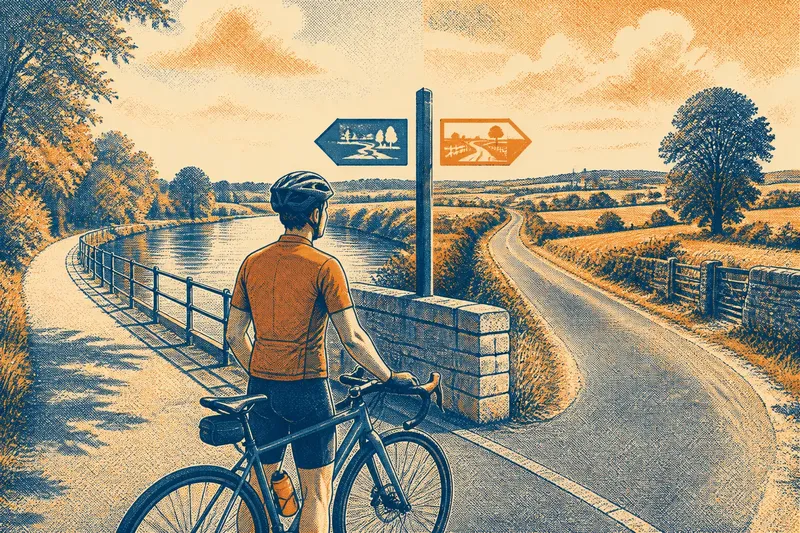
The common mistake in choosing a leisure route is treating a loop as automatically more interesting and an out-and-back as a compromise. Loop or out-and-back route planning is really a choice about what you want the ride to ask of you: notice new places, or travel a known line with a clear return. Pick the wrong shape and the cost may be a pleasant afternoon spent watching the clock, or a return leg that feels longer than expected.
Say you have a free afternoon in a town you know reasonably well, a bicycle, and no particular destination. You want a relaxed ride, not a navigation exercise. A riverside path runs east from your neighborhood to a bridge; a quiet road continues north from the bridge, then bends west through farmland and returns by a different road. The same bridge also makes a simple out-and-back possible. Neither route is inherently better. The useful question is what each shape will feel like at the point where you turn around, or choose not to.
What does each route shape ask of you?
An out-and-back uses the same broad corridor in both directions. You ride away from your starting point, reach a chosen turnaround, then retrace the route. The scenery is familiar on the return, but the view is not identical: slopes, sight lines, traffic direction, wind exposure, and the side of the road you occupy can change what you notice. This shape gives the ride a simple hinge. The turnaround is the hinge; the route itself needs little explanation.
A loop brings you back to the start by another way. It can feel like a small journey through several settings, even when the route is close to home. That variety comes with a planning cost: you need to understand how the sections join, where a shortcut or exit might be, and whether the final approach remains comfortable. A loop is not necessarily longer, but it is less forgiving of a missed turn if the alternatives are unclear.
Think of the shapes as a book you can close at a marked page versus a book with several chapters and a route between them. The analogy is modest, but useful: the first makes the return obvious; the second gives you more changing material and more transitions to keep track of.
How does the invented afternoon unfold?
Imagine the rider starts with a loose plan: follow the riverside path to the bridge, then decide whether to return the same way or continue into the farmland. The path is familiar, so the first section is easy to ride without checking a phone. At the bridge, the rider pauses, looks at the sky, and notices that the northbound road has more exposed stretches than the riverside path.
If the afternoon feels calm and the rider still wants to explore, continuing north turns the outing into a loop. The route now has a clear sequence: bridge, farm road, western lane, neighborhood. The rider checks that the western lane reconnects to a road they recognize, then keeps the bridge as a mental landmark rather than a mandatory return point. The likely result is a ride with changing surroundings and a few more moments of route attention.
If the rider is already content, or the exposed road looks unappealing, turning back makes the out-and-back a complete choice rather than a retreat. The river remains a reliable guide, and the bridge sets a natural endpoint. The likely result is a simpler ride whose return feels familiar, with less need to make decisions while moving.
The important detail is that the shape can be chosen at the bridge, not settled irrevocably at home. A route with a genuine decision point preserves options. That works only if the rider knows what lies beyond it; a vague line on a map is not an invitation to improvise blindly.
When is a loop the better fit?
Choose a loop when the appeal of the outing depends on seeing different surroundings or moving through distinct landscapes. A route might leave a canal path, cross a village, follow a farm lane, and return on a tree-lined road. Each transition gives the ride a fresh texture. Loops also suit riders who dislike covering the same stretch twice, provided they are comfortable keeping track of turns.
Look for a loop whose connections are legible. A clear bridge, a signed junction, a railway crossing, or a road that meets a familiar avenue can serve as a reliable reference. If the route depends on a narrow link between two roads, inspect that connection before setting out. A loop that looks tidy on a screen may contain a gate, a path unsuitable for your bicycle, or a junction that is hard to recognize from riding height.
Consider how the final section feels as well as how the first one looks. A loop that saves the busiest road for the end may be a poor match for a leisurely outing, even if most of it is appealing. The return to the start should be part of the route’s character, not merely the leftover line after the interesting portion.
When does an out-and-back make more sense?
An out-and-back is a strong choice when the route has a useful corridor: a waterfront path, a valley road, a greenway, or a quiet lane with few confusing branches. It lets you decide how far to go based on how the ride feels. The turnaround can be a bridge, a public square, a picnic table, or simply a point where the view changes and you have had enough.
It also helps when the destination matters more than route variety. Riding to a bakery, a park, or a village center and returning along the same path keeps the outing’s purpose easy to hold in mind. You can spend attention on the place you are visiting rather than on the sequence of roads that brings you home.
But do not assume the return will feel effortless because the road is familiar. A headwind that helped on the way out may oppose you on the way back. A gentle descent may become a climb, and an attractive stretch may feel repetitive after you have already seen it once. A sensible turnaround leaves room for the return leg to be part of the ride, not an afterthought.
Which questions help settle the choice?
Which route shape is easier to navigate?
An out-and-back usually asks for less route tracking because the return follows a known corridor. A loop can be straightforward too, but only when its junctions and connections are easy to identify from the road.
Is a loop always more varied?
It usually changes the scenery more, but variety depends on the actual roads and paths, not the shape alone. A loop that repeats the same kind of roadside for most of its length may feel less varied than an out-and-back beside a river that changes character as it winds.
How should I choose a turnaround point?
Pick a place that is easy to recognize and gives you a natural reason to pause, such as a bridge or a public space. Set the point with the return in mind, rather than judging the outing only by how far the outbound leg can go.
Can I combine the two shapes?
Yes: ride out on one route, then return on another only if the connection is clear and the second route suits the conditions. A partial loop can preserve a familiar start while adding variety, without requiring a grand circuit.
What should you check before setting out?
A little route-reading can prevent the shape from becoming an unwanted puzzle. Check the map at the scale of turns, not just the broad outline. Look for the features that will help you recognize where you are and for the places where the plan could reasonably change.
- Turnaround or closure point: Identify the bridge, square, park entrance, or junction that marks the key decision. Choose another point if it is vague or difficult to reach.
- Connection between loop sections: Confirm that the paths actually meet and that the link is suitable for your bicycle. If the connection is uncertain, use the out-and-back option or find a clearer route.
- Surface changes: Note where pavement gives way to gravel, packed earth, or a rough path. Match the route to your tires and comfort, or avoid the unsuitable section.
- Places to pause: Notice public spaces, shops, or sheltered spots along the way. A route with an obvious pause point can make a relaxed outing easier to pace.
- Return approach: Check how the last section reaches home, especially if it joins a busier road. If that ending does not suit the ride, revise the loop or turn back earlier.
- Simple exit options: Find a recognizable road or transit connection that could shorten the ride if plans change. Keep the route flexible without relying on an obscure shortcut.
Use the map as a planning aid, then keep one or two landmarks in mind rather than trying to memorize every bend. A phone can help confirm a junction, but it need not dictate the pace of the outing. If the route depends on a path’s access, surface, or local restrictions, check the relevant signs and current local guidance.
How can the route stay flexible without becoming vague?
Give the ride a main shape and a modest alternative. For the invented afternoon, the main plan might be the riverside out-and-back, with the farmland loop as an option after the bridge. That is different from leaving the whole route undecided. The rider knows where the choice occurs, what each option involves, and which landmark will bring the loop back toward home.
Keep the alternative genuinely optional. If the loop requires a difficult crossing, an uncertain path, or a stretch that only makes sense in favorable conditions, it is not a useful backup. Choose an alternative whose route can be read clearly and whose return does not depend on perfect timing or an unfamiliar shortcut.
When comparing a loop or out-and-back route, choose the shape that matches the attention you want to spend. A loop offers changing scenery and a small sequence of decisions; an out-and-back offers an obvious line and a natural point to turn. In the example, the bridge makes both possible, so the rider can choose after seeing the day’s conditions rather than treating one shape as the superior ride. For another outing, the best route may be the one with a clear landmark, a comfortable return, and enough room to stop when the ride has said what it needed to say.